What Is Business Analysis? Definition, Process and Examples
Business analysis bridges business problems and technical solutions by defining needs, gathering requirements, and ensuring changes deliver value. This guide covers the process, key skills, and real examples from CRM implementations to cloud migrations.
Quick Verdict
Business analysis is a disciplined approach to identifying business needs and determining solutions that deliver value to an organization. It bridges the gap between business problems and technical solutions—helping companies understand what needs to change and why.
In modern organizations, business analysis has become essential. Digital transformation, process automation, and evolving customer expectations mean companies constantly face complex decisions about where to invest resources. Business analysts bring structure to this chaos—they gather requirements, model processes, evaluate options, and ensure solutions actually solve the problems they’re meant to address.
This guide explains what business analysis is, breaks down the core process steps, and provides real-world examples from software implementation to digital transformation. Whether you’re considering a career in business analysis or just want to understand what business analysts do, you’ll leave with a clear picture of how this discipline works.
What Is Business Analysis?
Business analysis is the practice of enabling change in an organizational context by defining needs and recommending solutions that deliver value. It’s about understanding what a business needs to achieve and figuring out how to get there.
At its core, business analysis is a research discipline. It covers problem definition (what’s broken or missing?), stakeholder needs (who’s affected and what do they need?), requirements gathering (what exactly must the solution do?), and solution evaluation (did it actually work?). The work is equal parts detective work, facilitation, and strategic thinking.
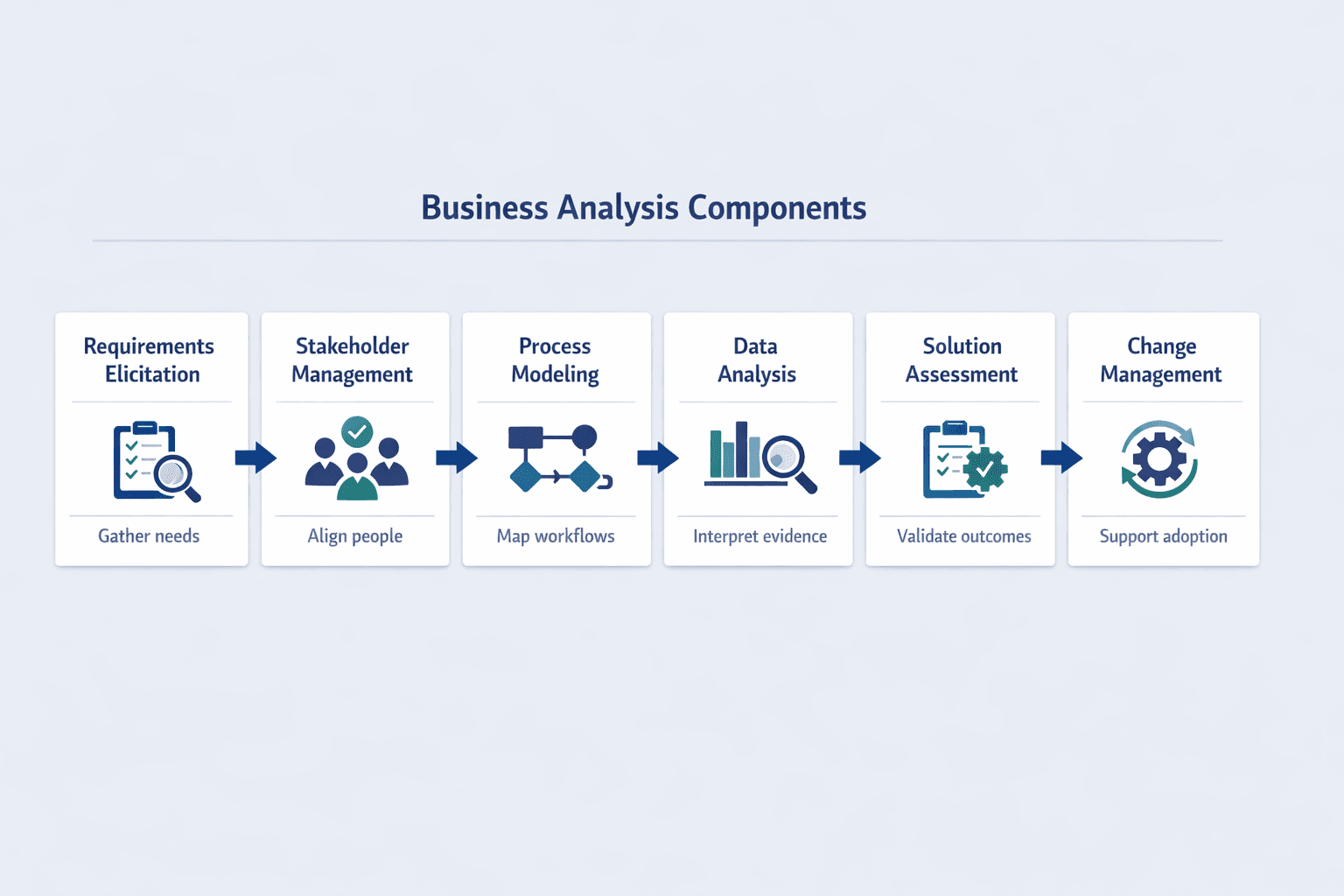
Key components of business analysis include:
- Requirements elicitation - Gathering information from stakeholders through interviews, workshops, and observation
- Stakeholder management - Identifying who’s impacted and keeping them aligned throughout the project
- Process modeling - Mapping current workflows and designing improved future states
- Data analysis - Interpreting information to support decisions and measure outcomes
- Solution assessment - Evaluating whether implemented solutions meet business needs
- Change management - Helping organizations adopt new processes and systems
Here’s an important distinction: business analysis is a discipline, not just a job title. Many professionals perform business analysis activities—product managers, project managers, IT consultants, operations leads. You don’t need “business analyst” on your business card to do business analysis work.
The Business Analysis Process
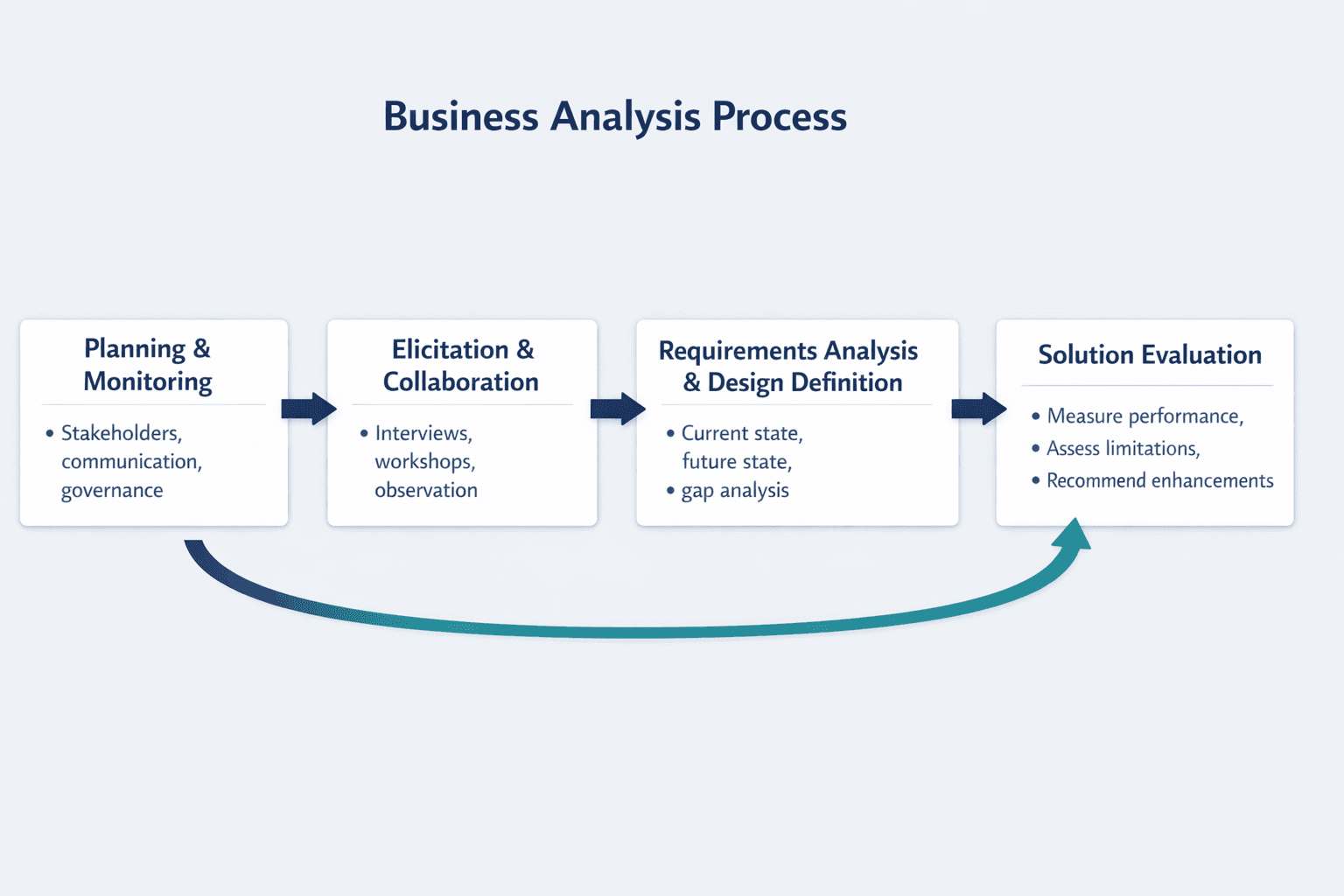
Business analysis follows a systematic process with defined phases. But don’t think of it as purely linear—several activities happen simultaneously, and most are iterative throughout a project.
Planning and Monitoring
Business analysts define their approach and plan activities before diving into requirements. This includes deciding which stakeholders to engage, how to communicate findings, and how to track progress throughout the initiative.
Key planning activities include:
- Stakeholder analysis - Identifying who needs to be involved and how to engage them
- Communication planning - Deciding how and when to share information with different audiences
- Governance approach - Establishing decision-making authority and approval processes
- Information management approach - Planning how to organize, store, and share requirements
- Performance monitoring - Setting up checkpoints to assess whether BA work is delivering value
Planning isn’t a one-time kickoff task. Business analysts revisit their approach as projects evolve—what works in discovery might need adjustment during implementation.
Elicitation and Collaboration
Elicitation is gathering information from stakeholders and working collaboratively to understand needs. It’s part structured interviews, part active listening, part detective work.
Common elicitation techniques:
- Interviews - One-on-one or small group conversations to understand individual perspectives
- Workshops - Facilitated sessions bringing multiple stakeholders together to align on requirements
- Surveys - Structured questionnaires for gathering input from larger groups
- Observation - Watching people work to understand current processes and pain points
- Document analysis - Reviewing existing documentation, reports, and system specifications
- Prototyping - Creating mockups or demos to clarify requirements through hands-on feedback
Elicitation continues throughout projects. Initial interviews might surface high-level needs, but detailed requirements often emerge later as stakeholders see prototypes or test solutions.
Requirements Analysis and Design Definition
Once information is gathered, business analysts analyze it to define clear requirements and recommend solutions. This is where raw input becomes actionable direction.
Core analysis activities:
- Modeling current state - Documenting how things work today—processes, data flows, system interactions
- Defining future state - Designing how things should work after the change
- Gap analysis - Comparing current and future states to identify what needs to change
- Solution options analysis - Evaluating different approaches and recommending the best path forward
- Feasibility assessment - Determining whether proposed solutions are technically and financially viable
Microsoft’s Dynamics 365 case study shows this in action—teams restated requirements around business transactions rather than abstract documents, which improved stakeholder engagement and made testing more effective.
Solution Evaluation
Business analysis doesn’t end when a solution goes live. The final phase is evaluating whether it actually solved the problem and delivered the expected value.
Evaluation activities include:
- Measure solution performance - Tracking metrics to assess whether the solution meets targets
- Assess limitations - Identifying constraints or gaps that remain after implementation
- Recommend enhancements - Proposing improvements based on post-launch findings
Solution evaluation closes the loop—it ensures organizations learn from what worked (and what didn’t) to make better decisions on future initiatives.
Business Analysis Examples
Business analysis applies across industries and scenarios—from software implementations to process improvements to enterprise-wide transformations.
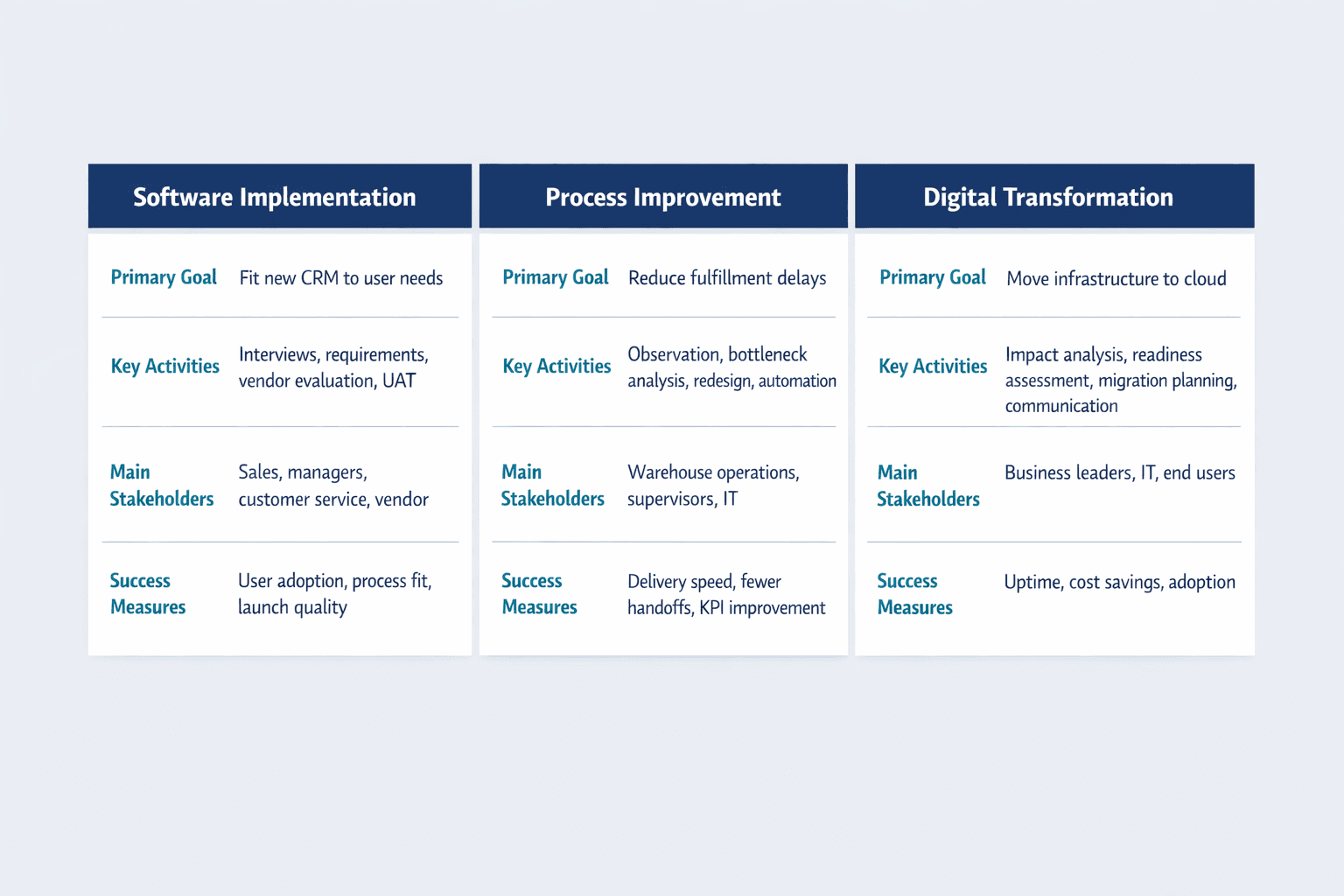
Example 1: Software Implementation
A mid-sized company decides to implement a new CRM system to replace spreadsheets and disconnected tools. The business analyst leads requirements gathering to ensure the system meets actual user needs.
Specific activities include:
- Stakeholder interviews - Talking with sales reps, managers, and customer service to understand current workflows and pain points
- Current process mapping - Documenting how leads move through the pipeline today and where data gets lost
- Requirements documentation - Translating business needs into clear specifications for the CRM vendor
- Vendor evaluation support - Helping compare CRM options based on how well they meet documented requirements
- User acceptance testing coordination - Working with end users to validate the system before launch
The Microsoft case study mentioned earlier used end-to-end processes to drive testing—a strong example of how analysis work carries through to validation.
Example 2: Business Process Improvement
A warehouse struggles with an order fulfillment process that consistently misses delivery deadlines. A business analyst steps in to identify bottlenecks and redesign the workflow.
Key activities:
- Process observation - Spending time on the warehouse floor watching how orders are picked, packed, and shipped
- Bottleneck identification - Analyzing data to pinpoint where delays happen most often
- Process redesign - Mapping a new workflow that eliminates unnecessary handoffs and wait times
- Automation recommendations - Identifying repetitive tasks that software could handle
- Metrics definition - Establishing KPIs to track whether the new process actually improves delivery times
DMAIC—a structured problem-solving approach from Six Sigma—provides a framework for this type of work. One healthcare example improved a nursing shift-change process from a sigma level of 0.7 to 3.3 using these techniques.
Example 3: Digital Transformation
A company plans to migrate its on-premises infrastructure to the cloud. The business analyst supports the initiative by assessing impact, planning the transition, and ensuring stakeholders understand what’s changing.
Core activities:
- Impact analysis - Identifying which business processes, integrations, and user workflows will be affected
- Change readiness assessment - Evaluating whether teams have the skills and resources to adopt cloud-based systems
- Migration planning - Working with IT to prioritize which applications move first and how to minimize disruption
- Stakeholder communication - Keeping business leaders informed about timelines, risks, and benefits
- Success metrics tracking - Defining measures like uptime, cost savings, and user adoption to gauge transformation success
Real examples help illustrate scale: 3M migrated more than 6,200 Amazon EC2 instances during its cloud transformation. Availity used AWS Professional Services to avoid architecture missteps, saving a full year of work in one migration. These initiatives required extensive analysis-driven planning and coordination.
Key Skills for Business Analysis
Effective business analysis requires a mix of technical knowledge and interpersonal skills. You need to understand systems and data, but you also need to communicate clearly and build consensus among stakeholders with competing priorities.
Essential skills include:
- Analytical thinking - Breaking down complex problems into manageable components
- Requirements elicitation - Extracting needs from stakeholders who may not know how to articulate them
- Stakeholder management - Building relationships and navigating organizational politics
- Communication - Explaining technical concepts to business audiences and business needs to technical teams
- Problem-solving - Identifying root causes rather than just treating symptoms
- Technical understanding - Knowing enough about systems, databases, and architectures to design viable solutions
- Process modeling - Visualizing workflows and data flows to clarify current and future states
- Data analysis - Interpreting metrics and evidence to support recommendations
The World Economic Forum’s Future of Jobs Report 2025 identifies analytical thinking as the top core skill among employers—reinforcing that this capability is foundational to business analysis work.
| Skill Type | Examples | Why It Matters | How It’s Applied |
|---|---|---|---|
| Technical Skills | Data analysis, SQL, process modeling tools, system architecture | Enables you to understand what’s technically feasible and translate business needs into workable specifications | Used when evaluating solution options, validating data flows, or writing technical requirements |
| Soft Skills | Communication, facilitation, negotiation, empathy, adaptability | Allows you to build trust, resolve conflicts, and keep stakeholders aligned when priorities compete | Used when running workshops, presenting findings to executives, or mediating between business and IT teams |
IIBA reports an average salary of $93,186 for business analysis professionals, and 69% say AI is positively impacting their careers—indicating that technical fluency and adaptability continue to grow in importance.
Business Analysis vs. Related Disciplines
Business analysis overlaps with several related fields, which can cause confusion about where one role ends and another begins.
Business Analysis vs. Data Analysis
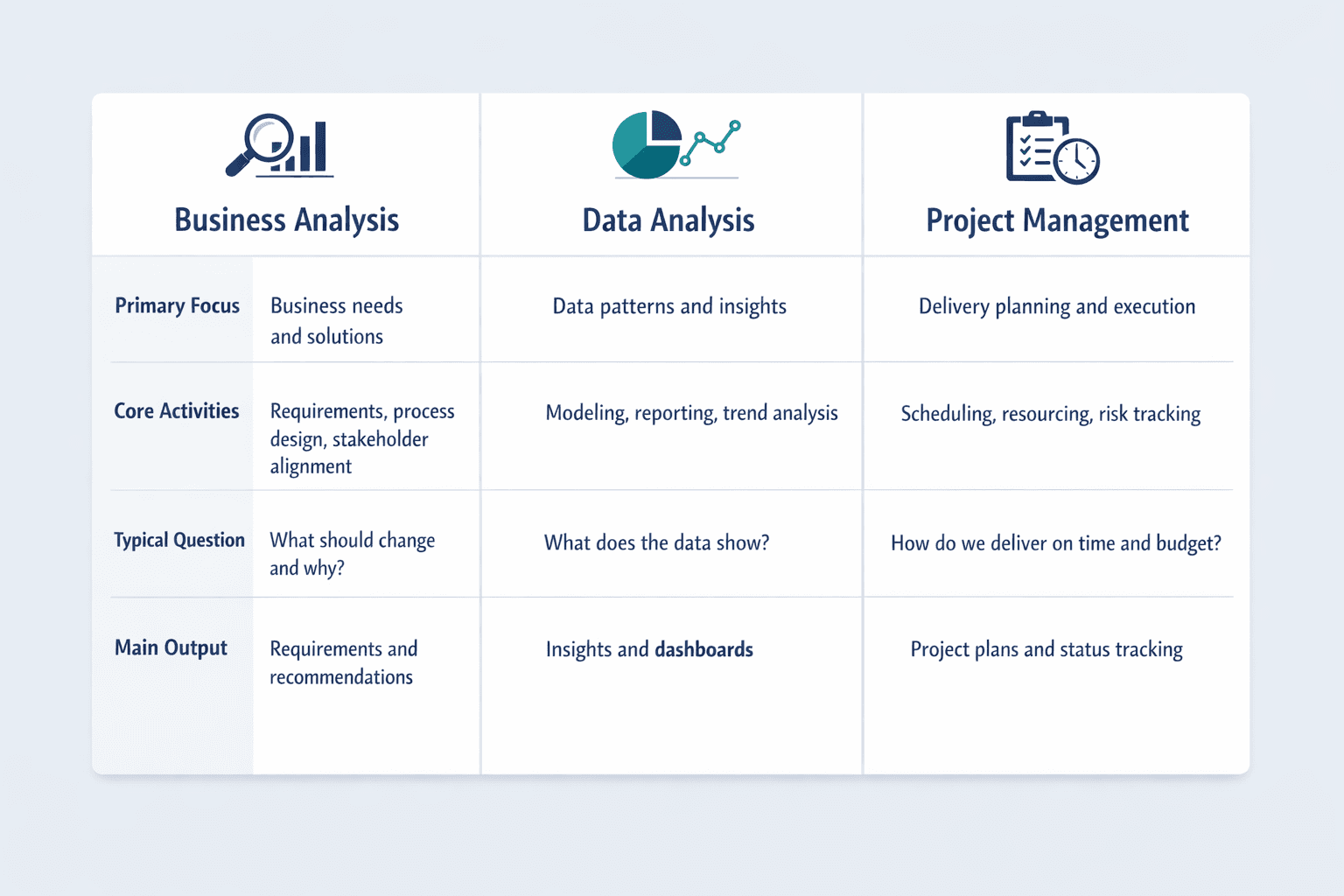
Business analysis focuses on defining business needs and recommending solutions. Data analysis focuses on interpreting data patterns and deriving insights from evidence.
Here’s the distinction: a business analyst might define requirements for a new reporting dashboard and identify what metrics matter most to stakeholders. A data analyst would then build the dashboard, analyze trends in the data, and surface insights about performance.
Both roles use analytical thinking, but the scope differs. Business analysis spans stakeholder engagement, requirements, process design, and solution evaluation. Data analysis typically centers on extracting meaning from datasets.
Business Analysis vs. Project Management
Business analysis clarifies what needs to change and why. Project management focuses on how to deliver that change—planning, scheduling, resource allocation, and execution.
PMI’s Professional in Business Analysis certification reinforces this: business analysis expertise is used to improve overall project success, but the two disciplines are complementary rather than interchangeable.
In practice: a business analyst defines requirements for a new inventory system and recommends the best solution. A project manager creates the plan to implement it, assigns tasks, tracks progress, and ensures the initiative stays on schedule and budget.
Business Analysis vs. Business Intelligence
Business intelligence typically centers on reporting, dashboards, and analytics outputs—helping organizations monitor performance and make data-driven decisions.
Business analysis is broader. It includes understanding stakeholder needs, gathering requirements, designing processes, and evaluating whether solutions deliver value. BI is one perspective within the larger discipline of business analysis, not a full substitute for it.
A BI team might build dashboards showing sales trends. A business analyst would work with stakeholders to understand why those trends matter, what decisions they support, and whether the organization needs new processes or systems to improve performance.
Business Analysis Frameworks and Standards
Established frameworks provide common language and best practices for business analysis work. They help practitioners apply consistent techniques across different projects and industries.
Major frameworks include:
- BABOK Guide - The Business Analysis Body of Knowledge from IIBA, the globally recognized standard covering six knowledge areas and 30 tasks
- Agile BA practices - Techniques adapted for iterative development environments, covered in IIBA’s Agile Extension to the BABOK Guide
- Six Sigma DMAIC - Define, Measure, Analyze, Improve, Control—a structured problem-solving approach for improving existing processes
- Lean methodology - Principles focused on creating value with fewer resources and eliminating waste
- PMI Professional in Business Analysis - Certification recognizing expertise in business analysis tools and techniques for project success
These frameworks aren’t rigid prescriptions. They provide structure and shared vocabulary, but practitioners adapt them based on organizational context, project scope, and industry requirements.
FAQ
What is analysis business?
“Analysis business” is typically a phrasing variant of “business analysis”—the practice of enabling change in organizations by defining needs and recommending solutions that deliver value.
The term can also occasionally refer to consulting firms or service providers specializing in analytical work for other businesses—but in most contexts, it’s just another way of saying business analysis.